The Importance of Beta Readers and Editors
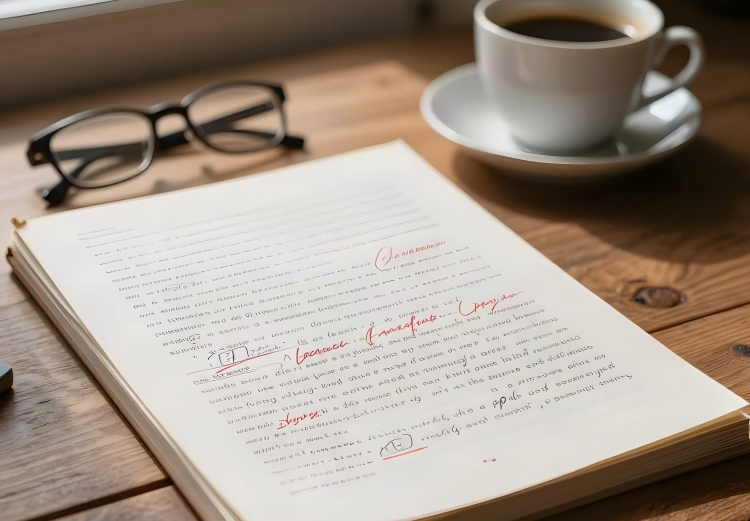
My husband read the first draft of Checked Out at the Imperial twice before he said anything true about it. The first read was encouragement, the kind you give someone who has just handed you four months of their life and is standing there watching your face. The second read was the one that mattered, and it took him three days to work up to telling me that the murderer's motive didn't survive contact with chapter nine.
He was right. It took me a further two days to stop being annoyed about that, and about a week to actually fix it. This is, as far as I can tell, how the process works for most writers who are serious about the work rather than just serious about having written something. You finish a draft. You believe, briefly and gloriously, that it is finished finished. Then someone else reads it, and you find out how much of that certainty was actually just fatigue wearing a convincing disguise.
I want to separate two things that get talked about as though they're roughly the same job, because treating them as interchangeable is where a lot of manuscripts go wrong. Beta readers and editors are not doing the same work, even when the same generous friend occasionally tries to do both.
What a beta reader actually gives you
A beta reader is a reader, first and foremost, and their value comes precisely from the fact that they are not trying to fix your manuscript. They are trying to read it the way an actual member of your audience will eventually, and to tell you honestly what happened while they did so.
Did they guess the killer by chapter six? Did they stop caring about the subplot with the vicar somewhere around the midpoint? Did they put the book down for three days and forget to pick it back up, and if so, where exactly did that happen? These are not craft questions in the technical sense. They are experience questions, and a writer who has spent a year inside a manuscript has lost the ability to answer them, because a writer who has spent a year inside a manuscript already knows who the killer is. Knowing spoils the experiment.
I use a small group of beta readers for every Paula Langford book, and they are not all writers. Some are simply people who read a great deal of crime fiction and have strong, unfiltered opinions about pacing. That's the point. I don't need them to tell me how to restructure act two. I need them to tell me they skimmed page 140 so I can go find out why.
What an editor actually gives you
An editor is a different kind of reader, and a genuinely useful one is trained to diagnose problems rather than merely report symptoms. Where a beta reader tells you they lost interest around chapter nine, a developmental editor can usually tell you why: the stakes flattened out, a character's goal stopped being clear, the red herring you planted was doing too much work and the real clue not enough.
That second edition of Checked Out at the Imperial went through a proper editorial process rather than a single pass, and it changed the book more than I expected a second look to change anything. The developmental work came first, sorting out the shape of the thing before anyone worried about a stray comma. After that came a copy edit, catching inconsistencies and clumsy phrasing I had read past a dozen times without seeing it. The final proofread found the sort of small errors a writer becomes structurally incapable of spotting in their own work, because the brain autocorrects what it expects to see.
Each of those passes required a different kind of attention, and asking one person to do all three at once is asking them to switch specialisms mid-sentence. It's a bit like asking your GP to also do the surgery and then run the physiotherapy afterwards. They might manage it. It isn't the arrangement I'd choose if the outcome mattered to me.
Why you need both, and why the order matters
The temptation, especially for a first book, is to skip straight to editing and treat beta readers as an optional extra for people with time on their hands. I understand the impulse. Editing feels like the serious, professional stage, and beta reading can feel like asking your friends for a favour.
But sending a manuscript to a professional editor before it has been tested on real readers means paying someone, often quite a lot, to fix problems that better structural instinct might have caught for free. Beta readers earlier in the process can surface the big shape problems, the ones that would otherwise cost real money to diagnose properly. Bring the editor in once you already have a reasonable idea of where the book is soft, and their time goes toward genuinely difficult problems instead of ones your readers would have flagged in a week.
There's an emotional order to this too, which nobody warns you about. Beta reader feedback tends to arrive as reactions, sometimes contradictory ones, and it's tempting to treat every comment as instruction. It isn't. If three readers all trip over the same paragraph, that paragraph has a problem. If one reader didn't like your protagonist's job, that's a preference, not a diagnosis. Learning to tell those apart is its own skill, and it took me longer to develop than I'd like to admit.
The part where you have to actually listen
None of this works if you can't hear the feedback without immediately explaining why the reader is wrong. I have watched other writers do this in critique groups, watched the useful comment land and then watched the writer talk their way around it in real time, and I have absolutely done it myself, usually about the exact note that turned out to matter most.
My husband's note about chapter nine stung because he was right, and being right is often what stings. The version of the book that exists now, the one people actually bought, has a motive that holds up because someone I trusted was willing to tell me it didn't, and I was eventually willing to believe him.
That's really the whole argument. Good beta readers and good editors cost you something. Sometimes it's money, sometimes it's a bruised ego over breakfast. What they give back is a book that survives its readers rather than merely surviving you.