Expanding My Author Brand Beyond Cosy
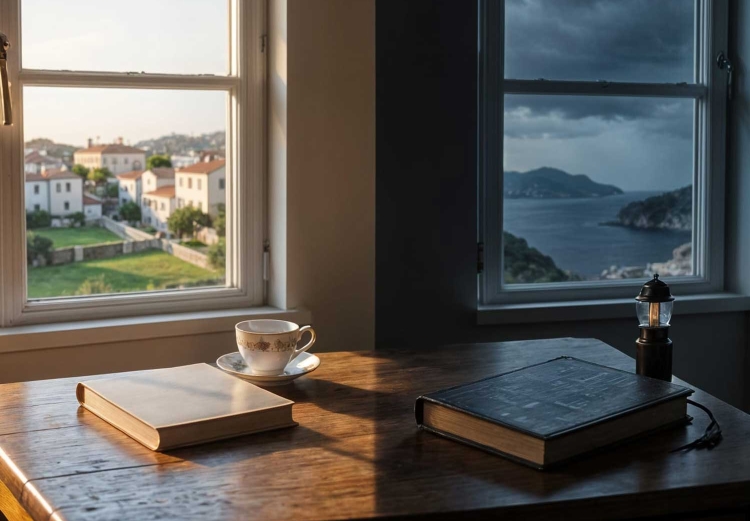
The body in a cosy mystery tends to arrive politely. It is discovered rather than witnessed; the violence took place somewhere out of view, and somebody puts the kettle on before the vicar is questioned. In a thriller, the body is more likely to arrive with a warning attached, and whoever finds it has a fair chance of being next. The crime might be identical on paper, but the promise each book makes to its reader could hardly be more different, and that gap is the whole subject of this post.
Where I started
My first books were cosy mysteries, written with Agatha Christie and Richard Osman somewhere in the back of my mind. I wanted a puzzle that rewards attention, set in a close community with an atmosphere that makes a reader want to stay put. I still love that world and have no plans to leave it. Paula Langford has a fourth case taking shape on my desk.
I have always read thrillers as well, though. My taste runs to the less gritty end of that shelf: books that feel closer to real life, with more danger in them and a pulse that picks up as the chapters go on. The Forgotten Corpse was where that appetite finally got a hearing. A skeleton under a retired engineer's pool terrace and a cover-up dating back to 1991 gave me a story with a very different temperature from Brightcombe. I intend to write more books like it, with more action and a darker tone.
What actually separates the two
Before writing this, I did some reading, partly to check whether my instincts matched those of people who think about genre for a living. They mostly did.
The usual distinction is that a mystery asks who, while a thriller asks how it will end. In a mystery, the crime has already happened, and the sleuth and the reader work through suspects and clues together. Convention demands several plausible culprits and fairly placed clues, so that the final reveal feels earned. Cosy mystery sits inside that tradition and turns the volume down on violence, favouring a lighter tone, a small community and an amateur at the centre.
A thriller runs on suspense. The reader often knows more than the protagonist and watches the danger close in, which makes the experience closer to surviving than solving. The central character is frequently an ordinary person in a very bad situation, and pace does much of the work that puzzle structure does elsewhere. One discussion I came across summed it up as solving versus surviving, which seems about right to me.
The two overlap constantly. Thrillers contain mysteries, and mysteries can be thrilling. The Forgotten Corpse has a buried question at its centre, yet it is the danger around David that keeps the pages turning.
Why this matters for a brand
A genre is a promise. A reader who picks up a cosy expects to be comforted and gently entertained, and a reader who picks up a thriller expects to be unsettled. Hand either of them the other book without warning and disappointment is a real possibility.
The common advice for authors who cross a gap this wide is to use a separate pen name, and a cosy series alongside a darker thriller turns up in that advice as something close to a textbook example. The case is a sound one. It also carries costs: a second catalogue to build, a second mailing list, separate social accounts, another website and the mental effort of being two authors at once. Writers have managed it both ways. Iain Banks added a middle initial to separate his science fiction from his other novels, and Dean Koontz wrote under many names before eventually returning to his own.
I already publish under a pen name, and my fantasy novels sit under a different one, so I am hardly allergic to the idea. For crime, I have decided on a single name. Both strands share a reader who loves a good puzzle and a vivid sense of place, and splitting them would halve the attention each name received. I only have one pair of hands.
How to keep both strands happy
Clarity does most of the work. My website already divides the books into the Paula Langford cosy series and the other thrillers and mysteries, and the tagline above the header covers both. Covers and blurbs need to signal tone before anyone reads a word, so a cosy reader recognises a cosy and a thriller reader can see the menace in a darker book. In descriptions, I want to be plain about what is inside, including saying so when a book is darker. A reader who chooses it knowingly is far more likely to enjoy it than one who has been ambushed.
The constants matter too. Whatever the temperature, readers should recognise my voice and my habit of playing fair with the clues. If a brand is a name attached to a tone, it breaks the first time the tone changes. If it is attached to those qualities, it can stretch a long way without snapping.
The newsletter and social channels follow the same logic. I will say which strand each announcement belongs to, so readers can follow both or simply wait for the shelf they prefer.
What I am hoping for
Some readers will follow me into darker territory, and some will stay in Brightcombe, and I am happy with either. Which shelf are you on? I would love to hear whether you read across both, or whether one of them is where you live. The full catalogue is at chrishillsfarrow.com/books, with the cosy series and the thrillers in their own sections.