My Favourite Mystery and Thriller Authors and What I’ve Learned From Them
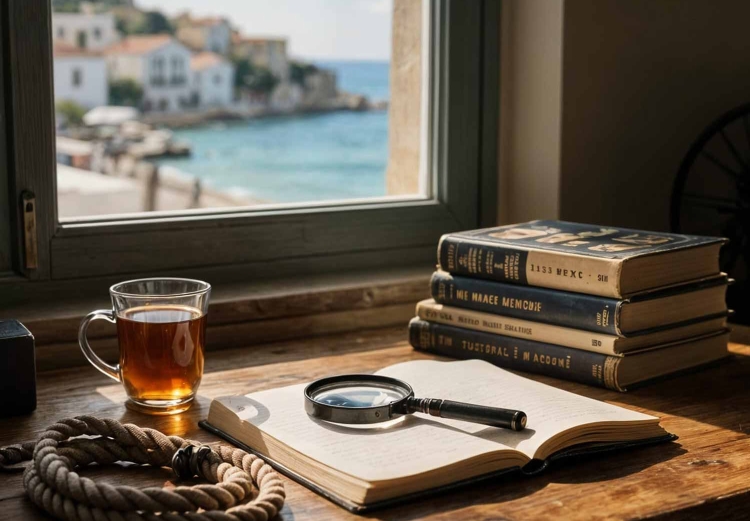
Anyone looking at my bookshelves would conclude that two different people live in this house and have agreed never to discuss it. One shelf is full of tidy village murders. The other is full of books that make me check the front door twice before bed. Both shelves are mine, and between them they have taught me most of what I know about the job.
Agatha Christie and the fair chance
Christie is where I first understood that a mystery is a contract with the reader. The clues are on the page, described in ordinary sentences between conversations about tea and train times, and the writer never taps the reader on the shoulder to say “this one matters.” On a reread, what stands out is how quietly she does it. The crucial detail arrives dressed exactly like every unimportant detail around it, and the eye slides past.
I try to hold my own books to that standard. I want a reader to reach the last page, flip back to the start, and find the clues sitting there looking innocent. A small flicker of irritation at themselves is welcome, because it means they had a fair chance. The balance is delicate, though. Make the clues too visible and the book is solved by Chapter 3, which leaves everyone with a lot of pages and no reason to turn them. The ideal reader is a step ahead of the protagonist at best, and certainly never a mile ahead.
Sherlock Holmes and the small detail
Conan Doyle’s great gift to the genre was the idea that a trivial observation can carry a whole case. A tan line or a worn boot says more than a dramatic speech ever could. Holmes taught me that specificity earns a reader’s trust, and that a reader who trusts the small facts will follow you into the large and improbable ones.
Nick Louth and the clue that looks like colour
Nick Louth takes the fair-play idea and applies it with a perfectly straight face. When I finish one of his books and look back, every clue is sitting exactly where it should be. I either read it wrongly at the time or barely registered it, because it seemed to be there for atmosphere. A casual remark about a character, the sort of thing people say while they chat about whatever is going on, can turn out to be holding up a great deal of the plot.
What I admire is his confidence. He does not underline the detail or give it a meaningful pause, and he trusts the reader’s habit of filing small talk under “background” to do the hiding for him. The reader is never cheated, because the information was handed over openly. They simply sorted it into the wrong drawer. It is the best illustration I know of how a reader can stay level with the detective and still miss the answer in front of them. I would love to pull that off in my own books, and I am still working on the nerve it takes.
James Herbert and the unease of ordinary places
On the darker shelf, James Herbert changed how I think about atmosphere. Before reading him, I assumed that dread needed the right scenery, such as a crumbling house, a moor or a convenient thunderstorm. Then I read a scene in which a character is busy with some perfectly ordinary DIY, and Herbert describes a rope as “coiled” at his feet. He could have written that it was lying there, and the sentence would have meant the same thing. The word “coiled” brings a snake into the room without ever mentioning one, and the reader feels a flicker of unease without knowing where it came from.
That is the technique I took from him. Herbert chooses words that mean the same as the obvious ones but carry darker undertones, so the scene stays exactly as ordinary as it was while the reader’s nerves quietly go to work. A garage, a garden or a kitchen needs no help from the scenery once the vocabulary has been chosen with care.
He is far from the only writer who understands this. Stephen King builds whole novels out of small towns and familiar routines and lets the strangeness leak in through the cracks. Herbert simply happens to be the one who first pointed it out to me, and a lesson tends to stay with you when it is the first one you notice.
Putting it to work on the Costa Blanca
This is the idea behind much of The Forgotten Corpse. David is stalked and threatened, and the story is set in a part of the world that most people associate with sunshine and holidays. The contrast was deliberate. Readers expect a threat in a dark alley. A threat in bright light is harder to shake, because the brightness takes away the usual hiding places and the usual comfort. A holiday coast also has an easy cheerfulness about it, and a story that sits uneasily underneath that cheerfulness has plenty to work with.
I did not need a haunted villa for any of this. A setting the reader already thought they understood, combined with words that carry a faint shadow, was enough.
What stays on the desk
If I had to boil it all down, the lessons come in two halves. From the mystery writers I learned to play fair and to let the evidence sit in plain view without a spotlight on it. From the horror writers I learned that ordinary places hold more menace than elaborate ones, as long as the vocabulary is chosen with care. The two halves turn out to work well together, which is convenient, since I seem unable to give up either shelf.