The Forgotten Corpse: A Reader's Guide
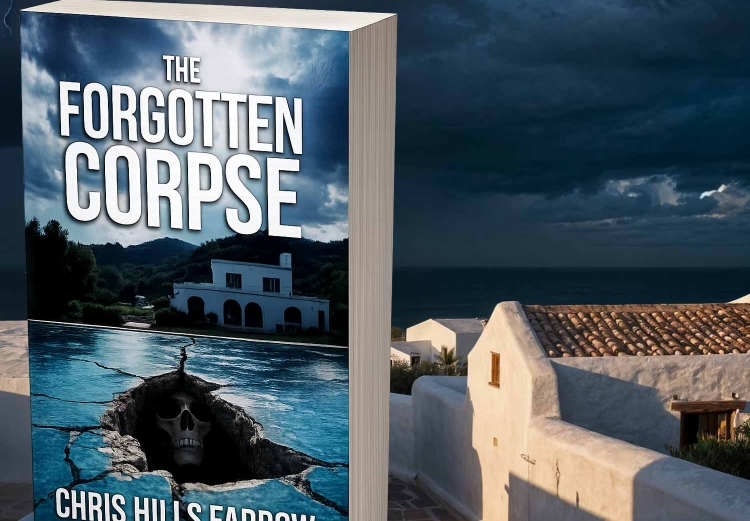
There is a particular kind of anticipation that comes with picking up a book you know almost nothing about. The cover caught your eye, or a friend pressed it into your hands with a look that suggested it would be worth your evening. You sit down, open the first page, and you have no idea yet what kind of story you are about to enter. I have always thought that is one of reading's great, irreplaceable pleasures.
But there is something to be said, too, for arriving with a little context. Not spoilers, but the kind of quiet orientation that helps a reader settle into a book's particular rhythm, understand the territory it inhabits, and know roughly what company they are keeping for the next several hundred pages. It is the literary equivalent of a good host telling you, as you take your coat off, that the food is slow-roasted and worth the wait.
With The Forgotten Corpse newly out in the world, I thought it was worth writing that note.
What Kind of Book Is This?
The Forgotten Corpse is a literary crime thriller, and that phrase is worth unpacking because it sits at a deliberate crossroads. It is not a cosy mystery. There are no drawing-room revelations, no village fêtes interrupted by inconvenient corpses, no detective inspector arriving with a weary expression and a notebook. Neither is it the kind of relentlessly paced procedural in which a new scene break arrives every three pages and the reader is kept in a state of breathless forward momentum.
What it is, instead, is a story that asks you to slow down. It is interested in atmosphere and in the weight of the past pressing against the present, in what it means to uncover something that powerful people spent decades burying. The crime at its centre is not fresh. It is thirty years old when the novel begins, and that distance is the point. The truth has had three decades to harden, for the people who knew it to become comfortable, for the cover-up to acquire the texture of ordinary life. Breaking it open requires patience and a willingness to look at uncomfortable things clearly.
If you come to it expecting the genre pleasures of a thriller, and they are there building steadily through the second half, I would ask you to be patient with the early chapters. The story earns its tension.
The Setting
The novel is set on the Costa Blanca, in the Valencia province of Spain, which regular readers of this blog will know is territory I find endlessly generative. There is something about the quality of light here, the particular mix of beauty and transience, the expat communities with their complicated relationships to belonging, that makes for rich fictional soil. David Darnell's villa, the terrace where everything begins, the landscape that both conceals and eventually reveals: all of it is drawn from a place I know well and think about constantly.
I would not describe the setting as picturesque window dressing. The Costa Blanca in this novel has its own moral climate. It is a place where money arrived quickly in the late 1980s and early 1990s, where development happened fast and oversight was sometimes conspicuously absent, where things were built and deals were done that did not always bear close examination. The 1991 at the novel's historical core is not an arbitrary date. That era, and what it meant for this corner of Spain, is very much part of the story.
The Two Protagonists
David Darnell is a retired engineer in his early sixties who bought his Costa Blanca villa intending to spend his later years in the sun, doing very little of consequence. He is practical, methodical, and fundamentally decent, a man who spent his career solving problems with precision and now finds himself, reluctantly, in the middle of a problem that does not yield to engineering logic. He does not want to be doing any of this. That reluctance is, I think, one of his most important qualities.
Lucía Sanchis is a journalist. She is younger than David, sharper-edged, and professionally accustomed to sitting with uncomfortable information and turning it into something the public can read. Where David hesitates, Lucía pushes. They are not an obvious partnership, and the negotiation of trust between them is as much the novel's subject as the murder itself.
I should say clearly: this is not a romance. There is warmth between these two characters and a mutual respect that builds over the course of the book, but the relationship is defined by the work they are doing together. Readers looking for that particular thread will need to look elsewhere.
Content Notes
I believe readers deserve honest guidance on this. The Forgotten Corpse contains references to institutional corruption and its human consequences, including a death that is depicted at a narrative distance and whose details emerge gradually. There is no graphic violence in the present-day story. What violence exists is historical and is handled with restraint. There are also references to the pressures faced by journalists in contexts where powerful local interests are involved, and to the personal costs of pursuing a story that certain people would very much prefer left alone. None of this is gratuitous, but it is treated seriously rather than glossed over.
There is no strong language that would trouble a general adult readership, and no sexual content.
Reading Tips
The novel rewards close reading of small details, particularly in the early chapters. I am not a writer who plants clues with neon signs around them, but I am also not a writer who plays unfair. If something is mentioned in passing in the first third of the book, there is usually a reason. Equally, the documents, photographs, and records that David and Lucía piece together are not decoration. What is present, and what is conspicuously absent, both matter.
The structure moves between the present-day investigation and the events of 1991, gradually bringing the two timelines into alignment. Some readers find it useful to keep a loose mental note of which characters appear in both threads and how they have changed over the intervening years, or sometimes more tellingly, how they have not.
This is, as I have said, a slow burn. It builds. The first chapter drops you into the discovery and then the novel takes its time assembling the full picture. If you are the sort of reader who occasionally checks how many pages are left in a chapter, I would gently advise resisting that habit here. The pacing is deliberate and, I hope, earned.
A Note on the Companion Website
For readers who enjoy a little additional texture alongside a novel, there is a fictional companion website, La Verdad Enterrada, which exists in the world of the book rather than in the real one. It is clearly marked as fiction. Think of it as something Lucía Sanchis might have built to document her findings, had the story concluded differently. You can find it at laverdadenterrada.com. I had a great deal of fun building it, and I hope it adds something for readers who are curious enough to look.
The Forgotten Corpse is available in paperback and ebook on Amazon, and as an ebook across all major platforms. If you do read it, I would be genuinely grateful for a review on Goodreads or Amazon. Reviews matter enormously for independent authors, and honest ones matter most of all.
I hope you enjoy it.