Five Books Later: My Author Journey from Midnight in the Aravis to Fatal Turn Of The Tide
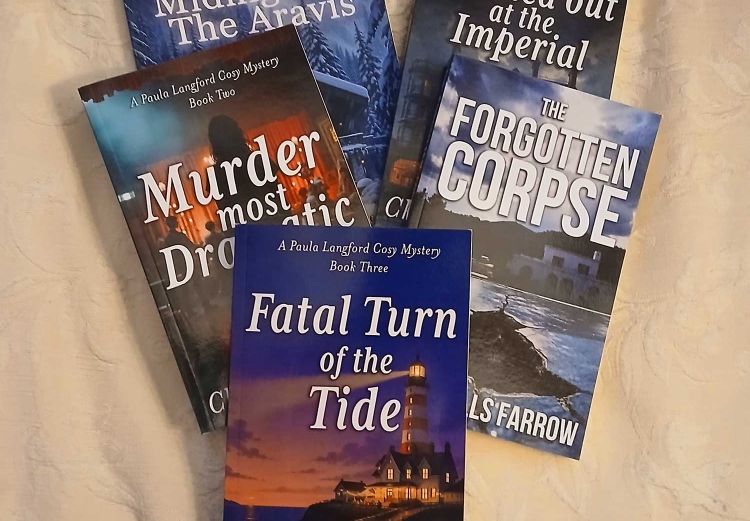
Midnight in the Aravis is the first book I wrote and the second book I published, which is the sort of detail that sounds like a quirk until you remember what it means. A book that finishes first and publishes second has usually spent a long time being argued with. This one was. Looking back across five published novels, and two fantasy novels written under another name, I can see the argument more clearly than I could at the time. I would like to think I have got better at having it.
The book that went first, and the book that went second
Checked Out at the Imperial was my first published novel, and it introduced Brightcombe and Paula Langford to the world. A head receptionist is found dead at her desk with a cup of tea beside her, and a genteel hotel has to cope with the fact that its hospitality has been used against it. It is a tidy, contained puzzle, and I am fond of it in the way you are fond of a first flat: grateful, a little embarrassed by the wallpaper, and aware that I learned how to live there by living there.
Midnight in the Aravis was written before it, and it shows how much I had still to learn. A wealthy family gathers at a ski lodge in the French Alps, old tensions come with them, and one of the guests does not make it to the end of the weekend. The idea was sound from the start. The execution was another matter, and it took a great deal of editing and rewriting to get it into a state I was willing to publish. Scenes that I had been proud of turned out to be doing very little. Conversations that sounded fine in my head sounded stiff on the page. Because it came first, it also taught me first, and some of what I know about cutting and rebuilding comes from the sheer volume of it I had to do there.
Learning to hear people talk
If I had to pick the single thing that improved most between those first two books and the ones that followed, it would be dialogue. In Midnight in the Aravis I had a lodge full of people who all wanted something and none of whom wanted to say it. That is a wonderful problem for a mystery and a difficult one for a beginner. Early drafts had characters explaining themselves in complete, tidy paragraphs, which is not how anyone speaks when they are hiding something.
The fix was rarely to add more. Sometimes a speech needed condensing until only the line a person would actually say remained. Other times an exchange was too clipped, and it needed room to breathe before it read like a conversation instead of a transcript of one. I now treat both as the same job. I am not trying to make dialogue longer or shorter. I am trying to make it sound like it belongs to a particular person on a particular bad day.
A town hall full of opinions
Murder Most Dramatic put that lesson under pressure. A heated council debate divides Brightcombe, the community hall is full, and a prominent figure tied to the controversial proposal is found murdered. A crowded room is a gift to a mystery writer and a trap for the same one. Every voice has to be distinct enough that a reader never has to flip back to remember who said what, and yet no one can be allowed to take over the scene.
This was the book where I got noticeably braver with the red pen. A debate scene can sprawl indefinitely, and the temptation is to include every grievance because each one was fun to write. I cut more of them than I would have in the earlier books, and the scene was better for it. Cutting stopped feeling like a loss and started feeling like editing, which is a different emotion entirely.
Taking my time with The Forgotten Corpse
The Forgotten Corpse was a change of direction. After the cosy mysteries I wanted to write something darker and more literary, set on the Costa Blanca, where a violent storm tears apart the pool terrace of a retired engineer’s villa and exposes something that should have stayed buried. The local explanations arrive a little too easily, and the people offering them are a little too keen for him to move on.
It is a longer, slower, more patient book, and I wrote it in a more patient way. I had always been in a hurry to publish once an edit was done, and this was the book where I finally slowed down. I became more methodical about structure, more willing to ask what each chapter was for, and more honest about the answer when it was “nothing much.” Cutting something for the pacing and rewriting it so the same point lands better are skills that get easier with practice, and this book gave me a lot of practice.
Fatal Turn Of The Tide, and where things stand
Fatal Turn Of The Tide is the most recent Paula Langford, and it begins with a wedding at Brightcombe’s working lighthouse that ends with a body at the foot of the stairs. Paula, who is meant to be managing a seating plan, finds herself managing something considerably more complicated.
It is also the book where my process felt most settled. The developmental edit rebuilt a central part of the plot, something I would once have defended for weeks and this time simply accepted was not working. I rewrote what needed rewriting, trimmed what needed trimming, and expanded the places where the dialogue was too brisk to feel natural. None of that was painless, but it was efficient, and it was done in a calmer frame of mind than the same work would have been in 2024.
Have I actually improved?
I hope so, though I am wary of anyone who claims to be the best judge of their own prose. What I can say is that the habits have changed. I plan more, I panic less, and I can tell the difference between a scene I love and a scene the book needs. When they are not the same scene, I now know which one wins.
Midnight in the Aravis remains the book that taught me that, slowly and at some cost. If you have read it and then read Fatal Turn Of The Tide, I would love to hear whether you can see the distance between them. If you have only read one, there is a bookshelf waiting for you at chrishillsfarrow.com/books, and a fourth Paula Langford is already taking shape on my desk.