What I Learned Writing The Forgotten Corpse
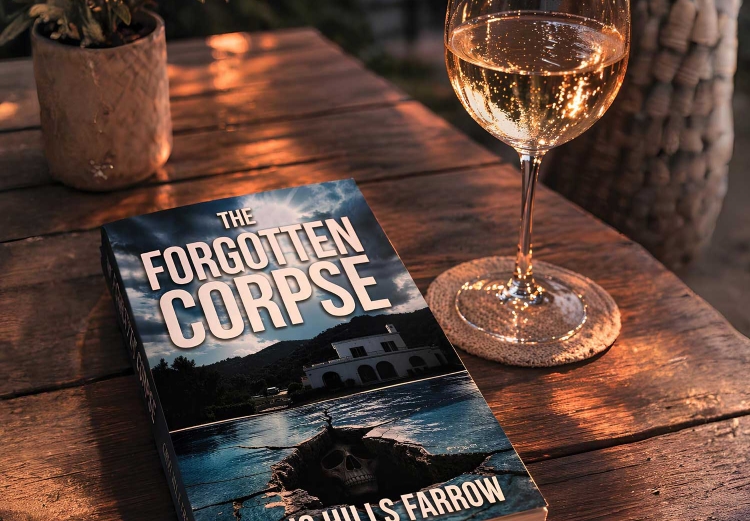
Writing a second type of book is a humbling experience. I say this as someone who has written cosy mysteries, such as the Paula Langford mysteries, and has some idea of how they work, how to pace them, how to plant clues, how to balance the warmth and the wickedness, and how to end a chapter in a way that makes putting the book down feel mildly irresponsible.
The Forgotten Corpse taught me that knowing how to do one thing well is a very different skill from knowing how to do a different thing at all.
In no particular order, here are the key lessons I learned.
Writing darker means shifting every gear, not just the top one
The Paula Langford books are warm. People die in them, obviously, because that is something of a prerequisite, but they die in a world that is fundamentally benign, populated by characters who are recognisable and mostly decent, in communities where justice tends to arrive satisfyingly and proportionately.
The Forgotten Corpse is not that. It is a novel about institutional corruption, buried secrets, and the way that ordinary people, not monsters, just people making self-interested choices, can collectively do something monstrous and then live with it for decades. Getting that tone right, and keeping it consistent across 76,000 words, required writing in a genuinely different register. Not just adding more shadow to the same picture, but starting from a different palette entirely.
What I kept getting wrong in early drafts was that I would occasionally slip back into a lighter gear without noticing. A character observation that would be perfectly at home in Brightcombe landed with the wrong weight in Albaret. Learning to feel when the tone was drifting, and why, was probably the single most important craft development this book required.
Your setting has to do more work than you think
I knew when I started that the Costa Blanca was going to be central to this book. What I did not fully appreciate until I was deep into the revision process was just how much structural weight the setting needed to carry.
In a cosy mystery, the setting is a community. It provides character, texture, comedy, and the comfortable sense of a world with its own rules and rhythms. That is important work, but it is essentially decorative.
In The Forgotten Corpse, the setting has to be complicit. The sunshine, the heat, the particular way that the expat community cultivates a talent for not asking difficult questions, all of it needed to be actively participating in the deception at the novel's heart. Every time I reviewed the manuscript and found the Costa Blanca functioning as backdrop rather than co-conspirator, I knew something had gone wrong. The place needed to be as guilty as the people.
Plant it, note it, resolve it
This is the lesson I wish someone had told me before I started.
Crime fiction, perhaps more than any other genre, runs on planted details. You seed something in chapter three that pays off in chapter seventeen. You introduce a character trait early that becomes significant later. You establish a piece of evidence that the reader will need to trust when it matters.
What I discovered in revision was that I had planted several details instinctively, correctly sensing they would be useful, without being entirely clear in my own mind about how or when they would land. Some of them found their resolution naturally. Others arrived at the climax without their payoff prepared, which meant they either quietly disappeared or required retrofitting.
The lesson is simple but bears repeating: when you plant something, write down what it is and what it is for. Your future self, seven chapters further on, will be genuinely grateful.
The middle act is where the novel is won or lost
The beginning of a novel is relatively easy to write with energy. Something happens, the world changes, the story begins. The ending carries its own momentum; you are pulling everything together, and the tension is doing the work.
The middle is where writers, including this one, can quietly lose the thread.
At one stage in the drafting of The Forgotten Corpse, I had written three consecutive chapters that each opened in essentially the same way: the same character, the same location, the same physical state, the same mood of helpless waiting. Each chapter was fine on its own. Together they created a rhythm that stalled the novel at exactly the moment it should have been accelerating.
The fix required stepping back from the individual scenes and mapping the middle act as a unit, asking not just whether each scene worked, but whether they worked together, whether each one moved something forward, and whether the sequence as a whole had shape. That is a different kind of editing from line-level revision, and it is a skill that I am fairly sure I have improved by writing this book.
Your habits follow you
Every writer has default constructions, the sentence shapes and transitional phrases they reach for without thinking. Mine are not wrong, exactly, but there are rather a lot of them, and when they appear frequently enough, they become invisible to the reader, which means they stop doing their job.
Reading your own manuscript with the specific question of what do I always do? is an uncomfortable exercise. I recommend it highly. The answer, in my case, involved a particular type of long sentence with several things happening at once, and a fondness for short declarative statements at the end of chapters that I had deployed so consistently it had become a tic rather than a technique.
Knowing what your habits are is the first step to choosing when to use them and when to find a different way.
Finishing is a skill
This is the one that surprised me most.
I am not talking about finishing the first draft, or getting to the end of revision, or approving the final proofread. I mean the specific, somewhat counterintuitive skill of knowing when a manuscript is done and letting it go.
A novel can always be improved. There is always another thing to tighten, another sentence to reconsider, another scene that might benefit from one more pass. At a certain point, that instinct, which is a good instinct and comes from caring, becomes the enemy of completion.
The Forgotten Corpse taught me to distinguish between a manuscript that still needs work and one that needs to be released. That is a judgment call, and like most judgment calls, it gets easier with practice. But it only gets practice if you actually finish things.
I hope you enjoy reading it as much as I eventually learned to enjoy writing it.
You can find The Forgotten Corpse here.