Designing The Forgotten Corpse: Sun, Skulls and the Art of the Sinister Cover
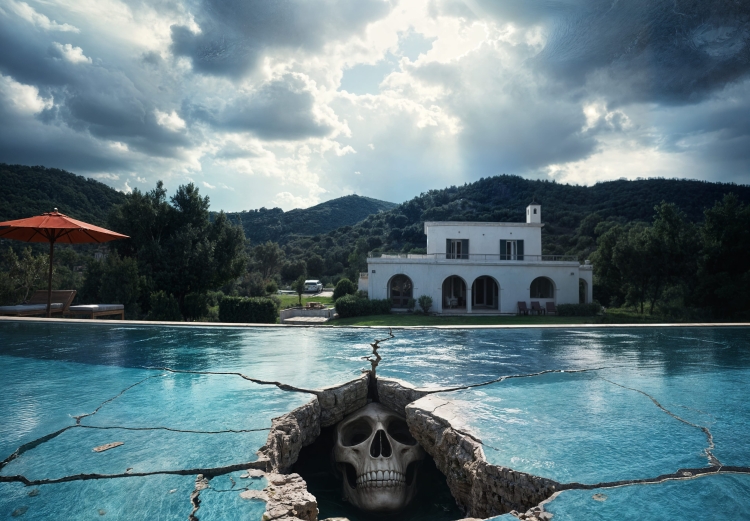
When it came to designing the cover for The Forgotten Corpse, I had two seemingly contradictory things I needed to achieve at the same time.
I wanted it to feel warm.
And I wanted it to feel wrong.
Those two things don't naturally sit together on a book cover, which is precisely why getting the balance right mattered so much. The Forgotten Corpse is a different kind of book from my Paula Langford series — darker, more serious in tone, set in a world where the sun is generous and the people are not always what they seem. The cover needed to signal all of that to a reader who might glance at it for no more than two seconds in a thumbnail grid.
Here's how we got there.
Starting with the genre
The first thing I did was look at covers across the European crime fiction category — the kinds of books that The Forgotten Corpse sits alongside. Books by Peter James, Chris Lloyd, Donna Leon. What they share is a visual language: strong contrasts, a sense of place rendered atmospherically rather than literally, and something slightly unsettling beneath an apparently ordered surface. Readers of this genre have learned to read those signals. They're looking for them, even if they don't know it consciously. The cover needed to speak that language fluently.
The Costa Blanca light
The novel is set on Spain's Costa Blanca, and one of the things that makes that setting so distinctive — and so useful for a crime novel — is the quality of the light. It's fierce and bright and pitiless. It bleaches everything. It makes shadows very dark and very sharp. It's the kind of light that makes things look beautiful and slightly overexposed at the same time, as if reality has been turned up a notch too far.
I wanted that quality in the cover. The brightness isn't decorative — it's thematic. This is a story about a place that presents one face to the world and conceals another beneath it. The warm, sun-saturated colours of the Costa Blanca are the surface. They're the explanation everyone offers David Darnell when he starts asking questions. They're the reason the town has spent thirty years not looking too closely at anything.
So the brightness had to be there. But it had to have something underneath it.
The skull
The decision to include a skull was not taken lightly. Skulls on crime covers can easily tip into cliché — the kind of design shorthand that signals thriller without saying anything specific about the book. I was very conscious of not wanting that.
What I wanted instead was a skull that felt discovered rather than displayed. Hidden rather than brandished. The skeleton in The Forgotten Corpse has been buried for thirty years — concealed beneath concrete, beneath a swimming pool, beneath the ordinary life of a house that has been bought and sold and renovated without anyone ever knowing what lay beneath the foundations. The skull on the cover needed to feel like something glimpsed rather than something shown. Something that makes you look twice and then feel slightly cold about having looked.
The skull represents the whole skeleton, of course — it stands in for the discovery, the secret, the thing that the storm uncovers and that nobody in Albaret wants David to examine too closely. But it also does something more specific: it sits beneath the brightness of the setting, half-hidden, which is exactly where the story's darkness lives.
Sinister beneath paradise. That's the book. That's the cover.
The typography
I am a firm believer that a cover that cannot be read as a thumbnail has failed at its most basic job. With so much book discovery now happening on phone screens, in Amazon grid views, in Instagram posts and email previews, the title needs to be legible at very small sizes without any ambiguity.
For The Forgotten Corpse, I chose a clean serif font — substantial enough to read clearly at a distance, with enough character to feel literary rather than functional. Serifs have a long association with quality crime fiction; they signal a certain seriousness of intent that sans-serif fonts don't quite carry in this genre. The title and author name are both set large enough to be readable at thumbnail size, with strong contrast against the background so they don't disappear into the imagery.
No clever overlapping of text and image. No decorative effects that sacrifice legibility. The words needed to be the first thing a reader's eye could resolve, even at postage-stamp size.
What I hope the cover does
If it works — and I think it does — a reader encountering The Forgotten Corpse for the first time should feel a specific thing: the pleasant warmth of a Mediterranean setting followed, almost immediately, by a slight unease that they can't quite pin down. They should want to look more closely. They should pick it up, or click on it, to work out what it is they just felt.
That's the whole job of a cover, really. Not to explain the book. Not to give anything away. Just to make a reader curious enough to read the first line.
I hope it does that for you.
The Forgotten Corpse is available to pre-order now, with release on 16 June 2026. You can find it here.