The Art of Slow-Burn Suspense in Literary Crime Fiction
There is a particular kind of reader who will tell you, with some satisfaction, that they knew something was wrong from the very first page. Not who did it, not what exactly happened, but that the world of the novel was tilted, that something beneath the surface was waiting to surface. They cannot always point to what gave it away. That is the point.
Slow-burn suspense is one of the harder things to do well in literary crime fiction, not because the mechanics are complicated, but because it requires a kind of patience that runs against everything the genre instincts tell you to do. The genre instinct says: keep moving. Give them a body. Give them a suspect. Give them something to chase. Slow-burn suspense says: wait. Let it accumulate. Trust the reader to feel the temperature dropping before they see the frost.
I have been thinking about this a lot while working on The Forgotten Corpse and in the time since it was released for pre-order, partly because advance readers have been kind enough to use that phrase, slow-burn, in their responses to it, and partly because I have been trying to understand, in craft terms, what it actually means and how it works.
It Is Not the Same as Slow
The first thing worth saying is that slow-burn suspense is not the same thing as a slow book. A slow book is one in which not enough is happening, and the reader knows it. A slow-burn is one in which a great deal is happening, but most of it is happening beneath the surface, in implication and atmosphere and the reader's own gathering unease, rather than in events on the surface.
The distinction matters because writers sometimes confuse the two. They think: literary fiction is allowed to be quiet, therefore I will be quiet. And then they wonder why readers disengage. The answer is usually that quietness and stillness are different things. A river can be quiet without being still. Slow-burn suspense keeps moving; it just keeps a lot of its movement below the waterline.
The question to ask of any scene in a slow-burn narrative is not whether something happens, but whether something shifts. The shift might be in the reader's understanding of a character. It might be in their interpretation of an earlier scene, which they are now mentally revising. It might simply be in the quality of the silence between two people in a room. But something must shift. If you re-read a scene and nothing has changed by the end of it, not plot, not character, not the reader's level of disquiet, then the scene is slow, not slow-burn.
The Architecture of Dread
Slow-burn suspense is, at its heart, an architecture. It is built, not stumbled upon. And the materials it is built from are not dramatic events but the small details that accumulate meaning over time.
This is something that prose writers have an advantage over screenwriters, though they do not always use it. The novel's interior access, the ability to be inside a character's perception, to see what they notice and what they miss, to register the feeling that something is wrong before the character has consciously named it, is precisely the tool that slow-burning suspense requires. A film can show you a character looking uneasy. A novel can show you the exact quality of that unease, the intrusive thought they keep dismissing, the slightly too-long pause before someone answers a question, the sense that the story they have just been told is tidier than the truth usually is.
The architecture works through accumulation. You lay out a detail early that seems unremarkable, a name mentioned once, a door that is always kept closed, a reaction that is slightly out of proportion to what prompted it. The reader files it away, or thinks they have. Later, something else lands, and the first detail shifts in its meaning. You are not revealing the mystery yet; you are building the reader's sense that there is one. By the time the narrative finally turns, and the full shape of what has been hidden becomes visible, a good slow-burn has been preparing the reader for exactly this revelation without ever quite letting them name it. The effect is not a surprise, or not only a surprise. It is recognition. They knew, without knowing that they knew.
Character as the Engine
In the kind of literary crime fiction I am drawn to, suspense does not live in the plot. It lives in the people.
A twisty thriller can sustain itself on mechanism: the next revelation, the next complication, the misdirection and the pivot. That is not a lesser form; done well, it is genuinely exhilarating, but it is a different form. Slow-burn suspense in literary crime fiction depends on the reader being deeply invested in the interior lives of the characters, because most of what accumulates is psychological rather than eventful.
In The Forgotten Corpse, the suspense is not really about whether David will find out what is buried under the terrace. It is about what finding out will cost him, and whether he is the kind of person who will pay that cost willingly or turn away from it. That is a character question, not a plot question. The plot is the mechanism by which the character's question becomes unavoidable. But if the reader does not care about David, if they are not invested in his particular way of half-knowing things while keeping himself at a careful distance from the full knowledge, then the slow accumulation of discovery lands flat. There is no dread without someone whose reckoning we are waiting for.
This is why literary crime fiction that tries to deliver slow-burn suspense without doing the character work tends to feel airless. The mechanics are there, the withheld information, the careful atmosphere, but there is no one for the reader to inhabit while the temperature drops. Suspense is not a property of events. It is a property of someone experiencing events.
The Role of Restraint
One of the counterintuitive things about slow-burn is that the moments of potential revelation are often more powerful when the novel turns away from them.
There is a technique, not unique to crime fiction but particularly useful in it, that I think of as the half-turn. A character comes to the edge of an understanding. The scene builds toward a moment of exposure or disclosure. And then the narrative steps back, moves to something else, or closes the scene before the explicit statement is made. The reader is left with the charge of the almost-revelation, which tends to be more potent than the revelation itself, because what they imagine filling the gap is shaped by everything they already feel and suspect.
Used well, this is exquisitely uncomfortable in the best way. Used carelessly, it is infuriating, because it reads as evasion rather than craft. The difference is in whether the scene has genuinely earned its withholding, whether the reader understands what was almost said, even without hearing it said,d or whether the writer has simply declined to write a difficult scene. Restraint requires confidence. You have to know what you are restraining, and you have to trust the reader to feel the weight of the unsaid.
Hemingway called it the iceberg theory. The dignity of movement of an iceberg, he said, is due to only one-eighth of it being above water. The analogy is almost too famous to be useful now, but the underlying point survives its own fame: the reader senses the submerged seven-eighths, and that sensing is part of the reading experience. In slow-burn suspense, you are always managing the relationship between what is shown and what is felt, and the felt part does the heavier work.
Atmosphere Is Not Decoration
I want to say something about setting and atmosphere here, because I think they are sometimes misunderstood as the soft furnishings of literary crime fiction rather than its structural elements.
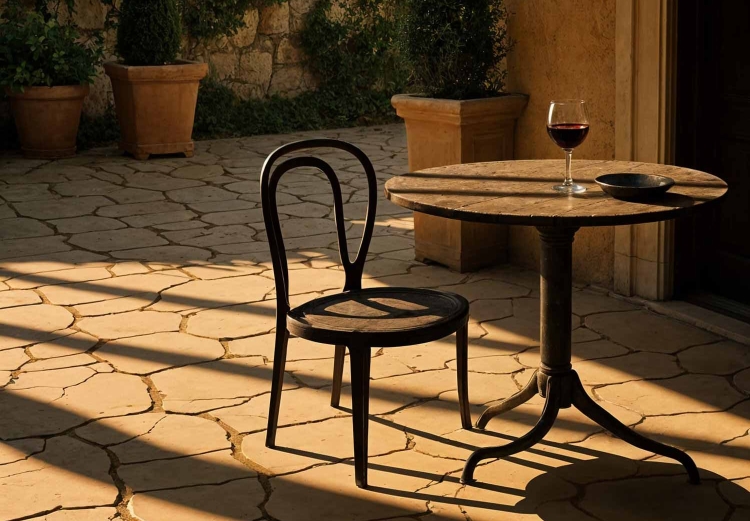
The atmosphere in a slow-burning narrative is not there to make the book feel literary. It is doing active work. The heat of a Spanish summer in The Forgotten Corpse, the particular quality of light that makes everything feel slightly bleached and exposed, the way an old property holds the memory of the people who built it, these are not background. They are the emotional register of the novel. The setting carries the suspense in the places where the plot is not.
This is worth thinking about if you are writing in this mode. What does your landscape know that your characters do not yet? What does the light do at the time of day when the important scenes happen? If you stripped out all your weather and your physical description, would the suspense survive? If the answer is yes, your atmosphere is probably decorative. If the answer is no, you have built it correctly, it is load-bearing.
When It Pays Off
The risk with slow-burn, the thing that makes it genuinely difficult, is that it demands more of the reader than a propulsive thriller does. It asks them to stay with discomfort that has not yet been resolved, to trust that the accumulation will be worth it, to hold the ambiguity without demanding that it be collapsed prematurely. That is not nothing to ask.
In return, when it works, it offers something a faster narrative cannot. The reader who has been held in sustained unease and has their instincts confirmed by the eventual revelation experiences something close to the feeling described by the philosopher Aristotle when he wrote about tragedy: not just the catharsis of the ending, but the particular satisfaction of having been carried through a difficult emotional journey and emerged on the other side of it. The slow-burn reader has been a participant, not just a recipient. They have felt things they could not yet name. They have known things they were not yet permitted to know.
Getting that right is the job. It is not the easiest job in crime fiction; in some ways, the cosy mystery, which knows exactly what it promises and delivers that thing with precision, is more forgiving of craft errors because its pleasures are more immediate. The slow-burn novel has to hold the reader's trust across a much longer stretch of sustained uncertainty, and that trust, once broken, is difficult to rebuild.
But when you are reading a book that does it well, you know. You feel it in the way a scene you thought was establishing becomes, twenty pages later, clearly sinister. You feel it in the particular quality of dread that is not fear exactly, but the sensation of knowing something is coming that cannot be stopped. You feel it when you turn the last page and think: of course. It could not have been any other way.
That is what the form is reaching for. That is the art of it.