Literary Crime vs Cosy Mysteries: Writing Both Without Losing Your Mind
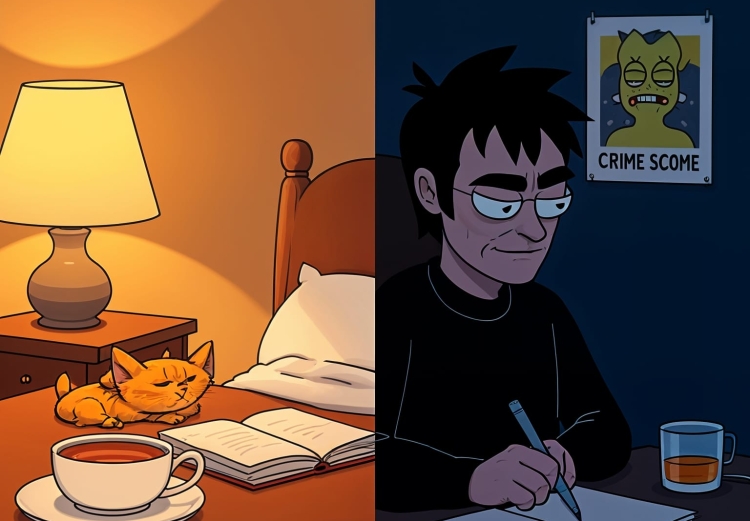
There is a question I get asked, now that The Forgotten Corpse is out in the world alongside the Paula Langford books: how do you write both?
The implicit follow-up, which people are usually too polite to say out loud, is: doesn't one of them contaminate the other?
It's a fair concern. The cosy mystery and the literary crime thriller are not just different in tone, they operate according to different rules, make different promises to the reader, and demand different things from the writer producing them. Sitting down to write Flash of the Lighthouse (the next book in the Paula Langford series) after working on The Forgotten Corpse is a bit like switching from a long-haul drive on a motorway to navigating a narrow country lane. Both require driving. The skills overlap. But the muscle memory that serves you brilliantly on one will cheerfully steer you into a ditch on the other.
So here is what I have learned, largely through the expensive process of making the mistakes myself.
They Are Not Just Different in Tone. They Are Different in Contract.
When someone picks up a cosy mystery, they enter into an implicit agreement with the author. Yes, there will be a body. Yes, the world of the novel contains danger and deception. But the fundamental nature of that world is safe. The darkness is bounded. Justice will arrive. The community at the heart of the story, whether a village, a tearoom, or a coastal town full of people who know each other's business, will endure.
That contract shapes everything: pacing, character, humour, the weight of the clues, the nature of the villain. A cosy can have a genuinely menacing antagonist, but that menace is domesticated. It operates within rules. Even the deaths, which in literary crime fiction might leave a residue of grief that carries through the rest of the book, are handled with a certain tact. The world is restored. The puzzle is solved.
Literary crime fiction makes a different promise. It says: I will not protect you from this. The past is going to be heavy, the present is going to be uncomfortable, and justice, if it arrives at all, may not look the way you expected. The world of the novel has real shadows in it.
Understanding that the difference is contractual, not merely tonal, was the thing that helped me most. I stopped thinking of the two forms as sitting on a spectrum where one was darker and one was lighter and started thinking of them as doing entirely different jobs. That made it easier to stay in the right register.
The Interior Life Problem
Here is something that catches writers out when they move between the forms. In a cosy mystery, a character's internal life is present but generally tidy. Thoughts are wry, observational, and occasionally self-deprecating. Interior monologue in the cosy mode is the voice of someone who is a little brighter than the people around them and knows it, but is far too well-mannered to say so directly.
In literary crime fiction, the interior life is where the whole thing lives. David Darnell's reluctance, his uncertainty, his complicated feelings about the history buried under his property, that is the novel. Strip it out, and you have a procedural. Keep it, and you have something that earns the word literary.
The practical problem is that when you switch from one project to another, you can find yourself dragging the wrong register along with you. I noticed, during early drafts of The Forgotten Corpse, that some of my characters were a little too knowing, a little too ready with an ironic observation. It was the cosy voice, perfectly serviceable in its own context, wandering into territory where it did not belong. The fix was less about rewriting the lines themselves and more about recalibrating whose head I was actually in.
The Plot Architecture Is Not the Same Shape
A cosy mystery is architecturally closer to a puzzle than a novel. That sounds reductive, and I don't mean it to be; a well-constructed puzzle can be a beautiful thing, and the discipline required to set one up and pay it off fairly is genuine craft. But the skeleton of the thing is: here is the crime, here are the suspects, here are the clues, here is the solution. The pleasure is retrospective. You re-read with satisfaction because you can see how neatly it all fitted together.
Literary crime fiction is architecturally closer to a journey. The mystery is there, in The Forgotten Corpse, the question of who put those bones under the terrace drives the narrative, but what the reader is really following is a sequence of revelations about character, history, and consequence. The solution to the crime is less a destination than a moment of reckoning. The architecture is layered rather than interlocking.
This matters practically because the drafting process feels different. With the Langford books, I plan in considerable detail before I write, because I need the structure to hold. With The Forgotten Corpse, I knew the shape but had to follow the characters into it. The structure had to be felt rather than assembled.
Neither approach is right nor wrong. They are just different jobs, requiring different working methods, and the sooner you accept that, the less time you spend applying the wrong method to the wrong project.
The Humour Question
Cosies use humour structurally. It is not decoration; it is a load-bearing element of the form. The wit, the gentle observation of human nature, the comedy of the amateur sleuth navigating situations they were not remotely trained for, all of that is doing real work. It is part of how the world of the novel is made safe. If you can laugh at something, it is not going to hurt you.
Literary crime fiction can have humour in it, real humour, not the nervous apology of a writer who is worried the book is getting too dark. But it cannot use humour structurally in the same way, because that would break the contract. A reader who has just been confronted with the full weight of three decades of cover-up and deliberate cruelty is not well served by a witty aside.
The mistake I see sometimes in books that try to blend the two forms is that the humour is either absent everywhere (too earnest, too airless) or present everywhere (which makes the darkness feel performative, like the author is winking at you through it). Knowing when to deploy it and when to hold it back is one of the more difficult tonal judgements involved in writing crime fiction at all, and it gets harder when you are working across both forms at once.
What They Actually Have in Common
Given everything I have just said about the differences, here is the thing: at the level of craft, they share more than people expect.
Both forms live or die on the quality of the central relationship. In a Langford book, it is Paula and whoever she happens to be investigating alongside. In The Forgotten Corpse, it is David and Lucía. If that relationship does not feel true, if the chemistry is not earned, none of the rest of it works. The mystery can be beautifully constructed, and the prose can be perfectly pitched, but if readers do not care about those two people in a room together, you have lost them.
Both forms require the writer to be completely honest about character motivation. The cosy mystery villain who does it for reasons that feel thin is just as much of a problem as the literary crime antagonist whose cruelty is unexplained. People do terrible things for comprehensible reasons; that is true in both registers. The difference is in how much space the novel gives those reasons, not whether they need to be there.
And both forms reward readers who pay close attention. That is the pleasure they share, the sense that the writer was always ahead of you, that the thing you thought was decorative turned out to be essential, that the world of the novel was more carefully built than it first appeared.
The Practical Answer
So how do you actually do it, write both, without one invading the other?
Honestly, I rely on a clean break between projects more than anything else. I do not try to hold both registers in my head simultaneously. When I am working on a Langford book, I am thinking in that world, with those characters, in that voice. When I come back to something darker, I give myself a transition period, usually the re-reading of the last draft, to get back into the right mode.
I also keep the two series at a physical distance from each other on my desk, which probably says something unflattering about how my brain works but seems to help.
The deeper answer is that the forms are not actually in conflict, because they are doing different things for different readers (and sometimes, gratifyingly, for the same reader who wants different things on different days). The Langford books offer comfort and puzzle. The Forgotten Corpse offers something heavier and more lingering. Both are, I hope, honest. And honesty about what you are trying to do, not trying to sneak the cosiness into the thriller, or the thriller's weight into the cosy, is probably the closest thing to practical advice I have.
The rest is just practice, and the occasional catastrophic early draft that never sees daylight.