Balancing Humor and Suspense in Cozy Mysteries
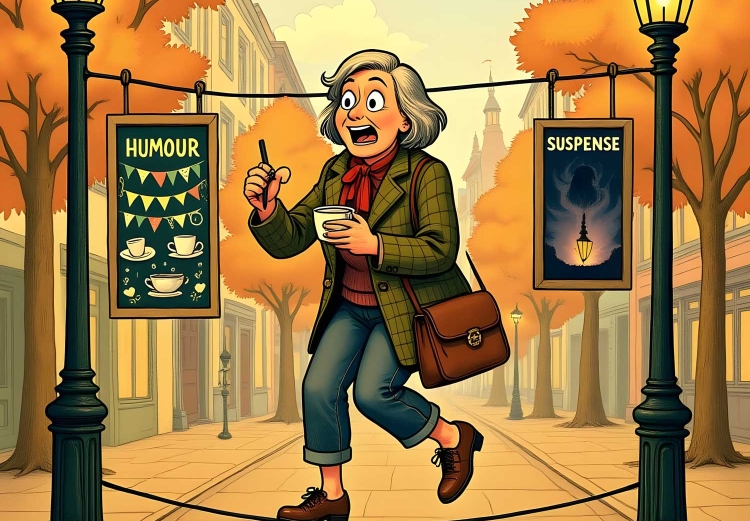
There is a peculiar tightrope that every cosy mystery writer must walk, and it goes something like this: on one side, a body. On the other, a joke about scones.
Fall too far in either direction and the whole thing collapses. Too much gloom and you're writing a psychological thriller that's accidentally been set in a village hall. Too many jokes and your corpse stops feeling like a corpse and starts feeling like a prop in a sketch show. Neither is what we signed up for — and neither, more importantly, is what our readers signed up for.
Getting the balance right is one of the genuine craft challenges of the genre. And having spent rather a lot of time thinking about it (and occasionally getting it catastrophically wrong), I have some thoughts.
😂 Why Humor Belongs in Cosy Mysteries At All
Let's start with the elephant in the room — or rather, the body under the floorboards. Cosy mysteries are, by definition, about murder. Someone is dead. This is not, on the face of it, a laughing matter.
And yet. The entire genre is built on the premise that death can coexist with warmth, community, and the occasional dry observation about the vicar's wife. The humor isn't there to trivialise the crime — it's there to make the world feel liveable. Humane. Like somewhere you'd actually want to spend 300 pages, even if the local mortality rate is statistically alarming.
Humor in a cosy is also how the author signals to the reader: you are safe here. Yes, someone's been poisoned, but the amateur sleuth's cat has just knocked over the evidence, and the detective inspector is staring at her with an expression of barely contained despair. The tone says: we are all in this together, and we will get through it.
😬 And Yet — The Suspense Must Be Real
Here's where it gets tricky. The humor cannot be so relentless that it defuses the tension entirely. Readers need to care about the mystery. They need to feel, at least occasionally, that something genuinely unsettling is afoot.
If every scene ends with a punchline, the story starts to feel like a sitcom that has accidentally acquired a corpse. The mystery becomes wallpaper. And the worst thing that can happen in a cosy mystery — worse even than a clumsy red herring or a villain who announces their guilt in chapter two — is for the reader to stop caring whodunnit.
The suspense has to be earned. Clues must feel meaningful. There should be moments when the warmth recedes slightly, when something genuinely dark flickers at the edges of all that cosiness, and the reader sits up a little straighter in their chair.
🎭 The Trick: Separating the Layers
The approach I find most effective — both as a reader and as a writer — is to keep the humor and the suspense in separate compartments, at least most of the time.
The characters can be funny. The dialogue can sparkle. The village gossip can be delicious and absurd. But the crime itself — the facts of it, the why of it, the creeping sense that someone in this cheerful community did something dreadful — should be treated with a certain gravity. You can have a comic scene immediately before a revelation, and immediately after one. But in the moment of revelation itself, let it land with weight.
This is something Agatha Christie understood instinctively. Her novels are full of wit, memorable eccentrics, and splendidly improbable situations — but when the final explanation comes, she never winks at the audience. She trusts the reader to hold both things at once: the pleasure of the entertainment and the seriousness of the crime.
🧪 Character as the Crucible
The best vehicle for balancing tone, I've found, is character. Specifically: a protagonist who is inherently funny without trying to be, and who is also genuinely invested in justice.
When your sleuth is naturally observant, slightly chaotic, and prone to getting into social situations that would make anyone's eyes water, humor emerges organically from the story. You don't have to insert jokes — the jokes arrive because the character is who they are. And when that same character is confronted with something truly disturbing, their emotional response grounds the reader in the seriousness of it.
The humor and the suspense aren't fighting each other. They're both coming from the same place: an authentic, fully-realised person navigating a genuinely strange and difficult situation. The reader laughs because they recognise something real. They feel the tension because they care about the same real person.
⚖️ A Word on Timing
Pacing matters enormously here. Comedy, as any stand-up comedian will tell you while looking haunted, is all about timing. So is suspense. The good news is that their rhythms are actually quite compatible — both depend on knowing when to hold back, and when to release.
A well-placed moment of levity after a tense scene can function as a pressure valve. The reader exhales. The story breathes. And then — if you've done it well — you can build the tension again from a fresh starting point, because the reader has just relaxed enough to be caught off guard again.
What you want to avoid is using humor instead of building tension. A joke at exactly the wrong moment doesn't defuse tension — it destroys it, and unlike a good soufflé, it doesn't come back.
🫖 In the End, It's All About Trust
The balance between humor and suspense in a cosy mystery is really a contract with the reader. You're promising them: this will be fun, and it will also matter. It will make you smile, and it will also make you want to know the answer.
When it works — when the reader is laughing at the eccentric suspects while simultaneously flipping pages at midnight to find out who did it — there's nothing quite like it. It's the cosy mystery at its absolute best.
And if you occasionally get it slightly wrong? Well. There's always the next chapter. Or, failing that, the next book.
Have you got favourite examples of cosy mysteries that nail the humor-suspense balance? I'd love to know — drop me a message or tell me in the comments. 🕵️♀️